


.)
Overview:
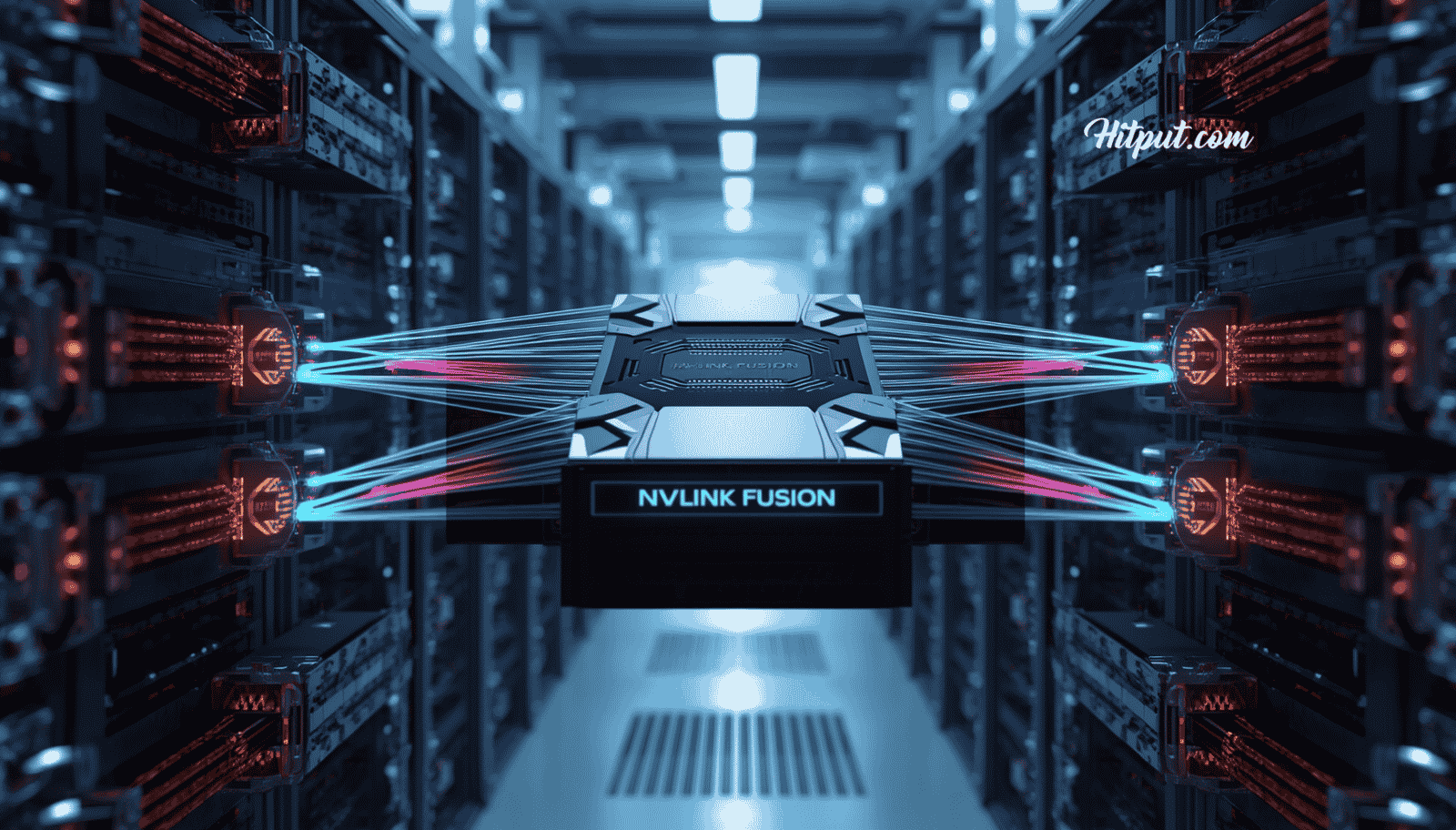
On March 31, 2026, NVIDIA announced a $2 billion investment in Marvell Technology via Series A convertible preferred stock. The partnership centers on NVLink Fusion, a rack-scale platform enabling third-party custom silicon to integrate with NVIDIA’s high-speed fabric. This strategic move targets the “inference inflection” and the “optical super-cycle,” utilizing silicon photonics to achieve 3.5x lower power consumption in AI data centers.
Hitput.com – The announcement on March 31, 2026, of Nvidia’s Investment in Marvell, has established a new technical and economic equilibrium within the semiconductor industry. This transaction, fundamentally centered on the launch of the NVLink Fusion platform, represents a decisive departure from NVIDIA’s historical reliance on a closed proprietary ecosystem. By integrating Marvell’s industry-leading portfolio in optical digital signal processors (DSPs), custom application-specific integrated circuits (ASICs), and silicon photonics, NVIDIA is effectively re-architecting the data center rack to serve as a unified compute domain. The implications of this deal signal the beginning of an “optical super-cycle” and the “inference inflection,” where the bottleneck of AI performance shifts from raw compute to the efficiency of the data pathways connecting processing units.
The Financial Architecture of the $2 Billion Strategic Alliance
The investment mechanism utilized by NVIDIA in this transaction reflects a deep, long-term commitment to Marvell’s operational success. According to Stocktitan, NVIDIA acquired 2,000,000 shares of Series A convertible preferred stock for a total of $2,000,000,000.00 in cash. This move provides Marvell with immediate liquidity while tying the interests of the two companies together at an equity level.
| Metric | Investment Detail |
|---|---|
| Total Capital Injection | $2,000,000,000.00 USD |
| Asset Class | Series A Convertible Preferred Stock |
| Initial Stated Value | $1,000.00 per preferred share 1 |
| Conversion Mechanism | Convertible into ~21,778,000 common shares |
| Initial Conversion Price | ~$91.8355 per common share |
| Dividend Entitlement | Pro rata with common stock on an as-converted basis |
| Voting Rights | Votes with common stock; excludes director elections |
The financial impact on Marvell’s balance sheet is transformative. Prior to the investment, Marvell held approximately $2.64 billion in cash; the addition of NVIDIA’s $2 billion grants the firm unprecedented financial flexibility to accelerate its 2nm development cycles and 1.6T networking components. For NVIDIA, the stake ensures that its primary partner for the NVLink Fusion initiative remains well-capitalized to meet the aggressive deployment schedules of hyperscale customers.
NVLink Fusion and the Technical Deconstruction of Heterogeneous Infrastructure
At the core of the partnership is NVLink Fusion, a rack-scale platform designed to enable the development of semi-custom AI infrastructure. Historically, NVIDIA’s NVLink was a “walled garden,” used exclusively to interconnect NVIDIA GPUs in dense, homogeneous clusters. By launching NVLink Fusion, NVIDIA has effectively opened its fabric to third-party silicon, provided that the overall architecture remains “NVIDIA-coherent”.
Suggested Article: Digital Marketing Trend 2026 You Must Know!
The technical requirements for NVLink Fusion participation are stringent. Every platform must incorporate at least one NVIDIA component, such as a Vera CPU, ConnectX NIC, or BlueField DPU, to terminate the connection on the NVIDIA fabric. Marvell acts as the lead design partner for the custom XPUs and scale-up networking components that bridge these diverse silicon environments. The interconnect provides staggering bandwidth, with benchmarks indicating speeds of up to 1.8 TB/s between fused components.
This architectural shift addresses the “inference inflection,” a period where the demand for real-time token generation in large language models (LLMs) requires specialized compute profiles. By allowing specialized accelerators to live on the same high-speed fabric as NVIDIA’s processors, data center operators can optimize their power-to-performance ratios without leaving the NVIDIA software ecosystem.
The Optical Super-Cycle and the Role of Silicon Photonics
The transition from 800G to 1.6T networking in 2026 is driven by the physical limitations of copper interconnects. As AI models grow, the energy required to transmit data across electrical wires becomes a significant bottleneck. Marvell’s leadership in optical DSPs and its strategic acquisition of Celestial AI provided the technological foundation for the NVLink Fusion optical roadmap.
Silicon photonics—the integration of optical signaling directly into the silicon substrate—is the proposed solution to this scaling problem. This technology eliminates bulky external DSPs and reduces the signal path from inches to millimeters, resulting in a 3.5x reduction in power consumption compared to traditional pluggable optical transceivers.
| Feature | Traditional Copper/Pluggable | Co-packaged Silicon Photonics |
|---|---|---|
| Power Efficiency | Standard Baseline | 3.5x Lower Power Consumption |
| Signal Integrity | 14–16 Inch Signal Path | < 0.5 Inch Signal Path |
| Bandwidth Scaling | Limited by Heat/Cross-talk | Scalable to multi-terabit/s |
| Deployment Speed | Standard Complexity | 1.3x Faster Deployment |
NVIDIA is leveraging Marvell’s expertise to integrate these photonic fabrics into its Quantum and Spectrum switch architectures. For the semiconductor industry, this marks a fundamental shift where Marvell is increasingly viewed as an “optical company” central to the $1.3 trillion AI semiconductor market.
Competitive Geopolitics: NVLink Fusion versus the UALink Consortium
The NVIDIA-Marvell alliance serves as a strategic counter-maneuver against the UALink Consortium, an industry group led by Broadcom, Intel, and AMD. UALink aims to create an open industry standard for high-bandwidth interconnects that would allow customers to bypass NVIDIA’s proprietary fabric. By formalizing the Marvell partnership, NVIDIA has effectively secured the most critical custom silicon partner.
Marvell’s position is unique because it remains a member of both the NVLink and UALink ecosystems. This “dual-citizenship” allows Marvell to act as the primary bridge for hyperscalers like Amazon and Microsoft, who may want to maintain their own custom silicon programs while still participating in the NVIDIA environment.
| Standard | Connectivity Type | Primary Beneficiaries | Current Status |
|---|---|---|---|
| NVLink Fusion | Semi-open; NVIDIA-coherent | NVIDIA, Marvell, Hyperscalers | Silicon shipping 2026 |
| UALink 1.0 | Open; multi-vendor | Broadcom, Intel, AMD | Silicon expected 2027 |
The Hyperscale Nexus: Amazon, Microsoft, and the Shift to Proprietary Silicon
Hyperscalers are projected to spend over $1.15 trillion on AI data center infrastructure between 2025 and 2027. A significant portion of this capital is being diverted toward custom processors like Amazon and Microsoft’s Maia program.
Amazon Web Services (AWS) has budgeted $200 billion for capital expenditures in 2026, with its custom chips achieving a combined annual revenue run rate exceeding $10 billion. The upcoming Trainium 4 roadmap is expected to provide 6x the FP4 compute performance and 4x the memory bandwidth of its predecessor. Marvell’s integration into NVLink enables it to support customers like AWS that are embedding.
Market Performance and Institutional Sentiment
The announcement of the $2 billion investment acted as a massive catalyst for Marvell’s stock, which saw an immediate 13% spike and a subsequent gain of 7.7% the following day. By mid-April 2026, Marvell shares have gained nearly 30% year-to-date, significantly outperforming the broader technology sector.
| Analyst Firm | New Price Target | Rating |
|---|---|---|
| B. Riley Financial | $156.00 | Buy |
| Barclays | $150.00 | outperform |
| Morgan Stanley | $103.00 | Equal Weight |
| BofA Securities | Increased Target | outperform |
Institutional investors, including FSM Wealth Advisors and Keel Point, increased their holdings in Marvell in late 2025 and early 2026, signaling confidence in the company’s transition to a data center powerhouse. While NVIDIA has faced some selling pressure from funds like Beacon Investment Advisory, which trimmed its stake by 3.7% in Q4 2025, the overall consensus remains bullish on the partnership.
Conclusion: The Architecture of the AI Industrial Revolution
The $2 billion investment and the launch of NVLink Fusion represent a fundamental reordering of the AI hardware hierarchy. NVIDIA has successfully transitioned from a chip vendor to a platform architect, ensuring that even as the world moves toward custom silicon, the underlying fabric remains within its sphere of control. Marvell, meanwhile, has been crowned as the indispensable architect of the “plumbing” for next-generation AI data centers.